Commercial Stainless steel Beer Brewing Tanks
Brewing tank is a general term covering various vessels used in commercial beer production, ranging from small 50-gallon brew kettles to large 300-barrel fermenters.
PRODUCT DESCRIPTION
Description
Brewing tank is a general term covering various vessels used in commercial beer production, ranging from small 50-gallon brew kettles to large 300-barrel fermenters. Your production scale will determine the type of brewing tank you require.
A fermenter is a vessel for microbial fermentation and the site where microorganisms carry out vital activities and metabolism. Ace manufactures fermenters in a full range of sizes and specifications to meet the demands of different breweries. Customers may select the most suitable fermenter based on their own requirements.
Due to the wide variety of beverages to be fermented, there are many types of fermenters. Ace has rich experience in producing fermenters for beer, wine, cider and kombucha. If you require other types of Fermentation vessels, please inform us and our engineers will design them according to your specific requirements.
Product Advantages
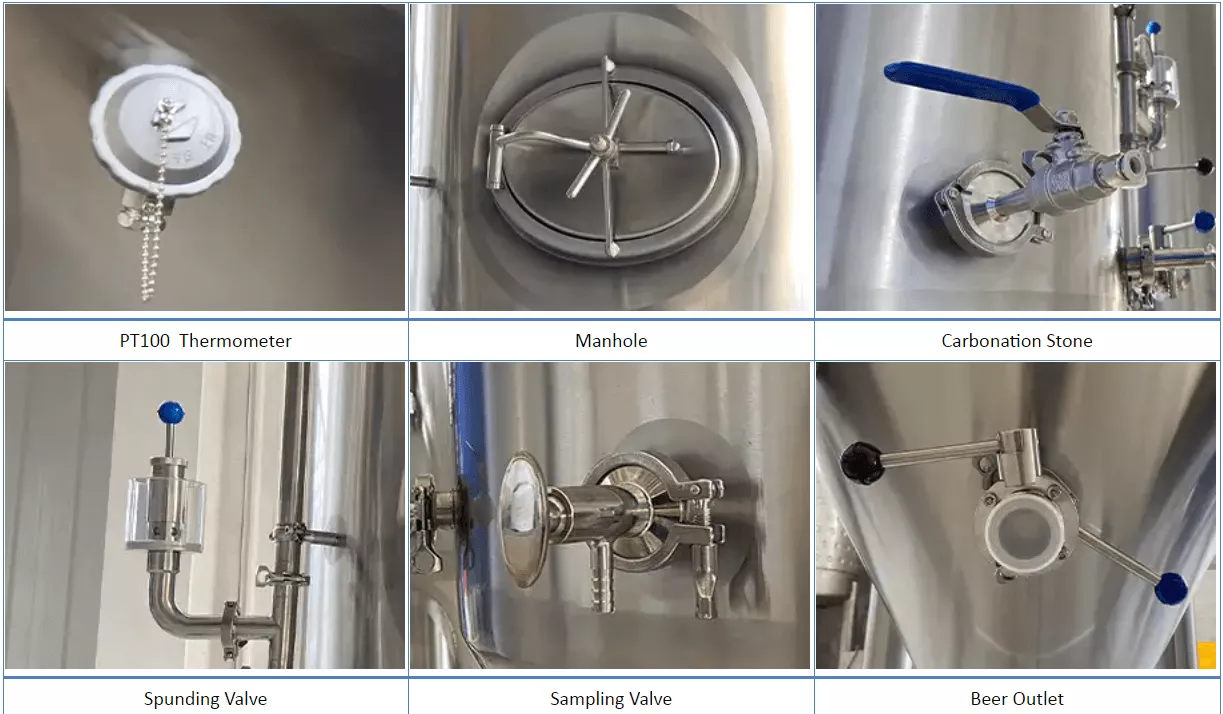
1. Lifting lugs are fitted on the fermenter for easy hoisting.
2. Rotating elbows enable convenient and flexible beer transfer with loading/unloading crews.
3. An elliptical guard plate is added at the joints of legs, lower cone refrigerant inlet pipe and lower cone outlet to guarantee higher machining precision.
4. All tanks are equipped with leveling bolts for proper alignment and levelling.
5. Clamps are installed at the connection between the product port and tank bottom; the joint can rotate freely for user convenience.
6. The outer cladding of the polished tank bottom adopts finished fabrication to ensure an attractive, robust and durable tank appearance.
7. Carbon stones for CO₂ sparging are installed inside all bright beer tanks.
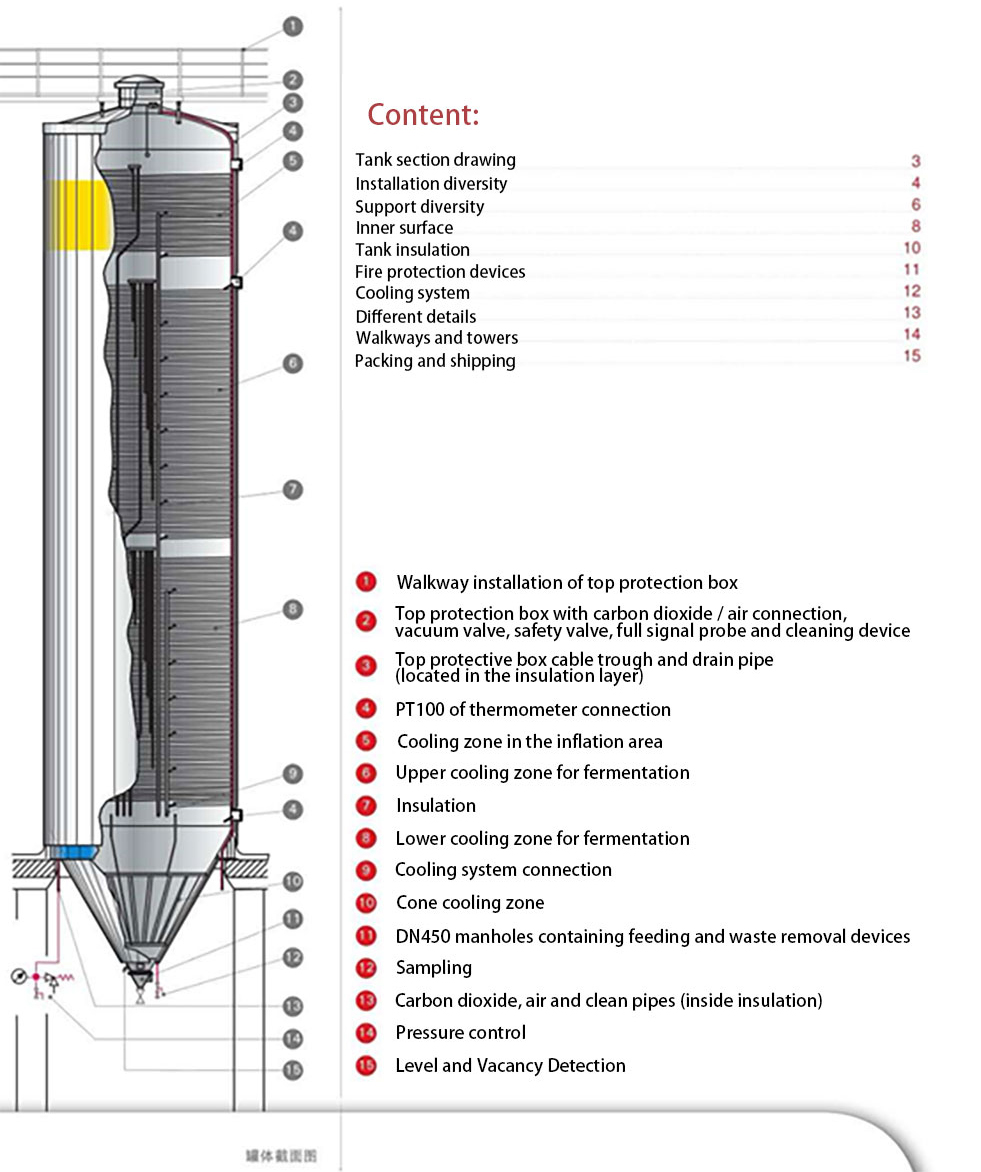
8. Shadowless manholes are adopted for easy cleaning. The top access port can be designed to match the customer’s fermentation process and beer brewing needs.
9. Ample headspace is reserved; the significance of total volume excluding headspace should be noted.
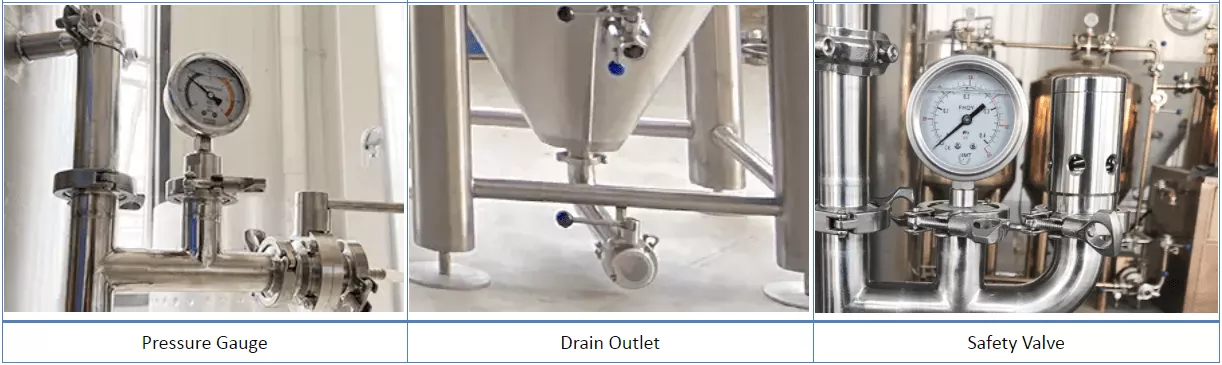
10. Cooling jackets are designed on both upper and lower sections of the cone to provide sufficient cooling area.
11. Fitted with safety devices and positive/negative pressure relief function.
12. The 60° cone angle is ideal for yeast sedimentation.
13. Fermenters are equipped with dedicated ladders for easy operation.
14. The working platform is designed to be waterproof and anti-slip.
15. Full-view glass manholes must be used for manholes in the brewing workshop.
Product Parameters
Effective volume | 500L | 1000L | 1500L | 2000L | 2500L | 3000L | 4000L | 5000L |
Total volume | 625L | 1250L | 1875L | 2500L | 3125L | 3750L | 5000L | 6250L |
Size | 960*2050mm | 1160*2500mm | 1260*2800mm | 1460*3050mm | 1700*3350mm | 1750*3450 mm | 1800*3550 mm | 1900*4250 mm |
Material | SUS304/SUS316 |
Control system | PLC Siemens or PID Schneider/ABB brand |
Cooling area | 1.3㎡ | 2.6㎡ | 3㎡ | 4㎡ | 4.4㎡ | 4.7㎡ | 6.3㎡ | 8.0㎡ |
Work pressure | inner jacket 0.4MPa; cooling jacket 0.5Mpa |
Design pressure | inner jacket 0.2MPa; cooling jacket 0.3Mpa |
Fermentation Tank Configuration
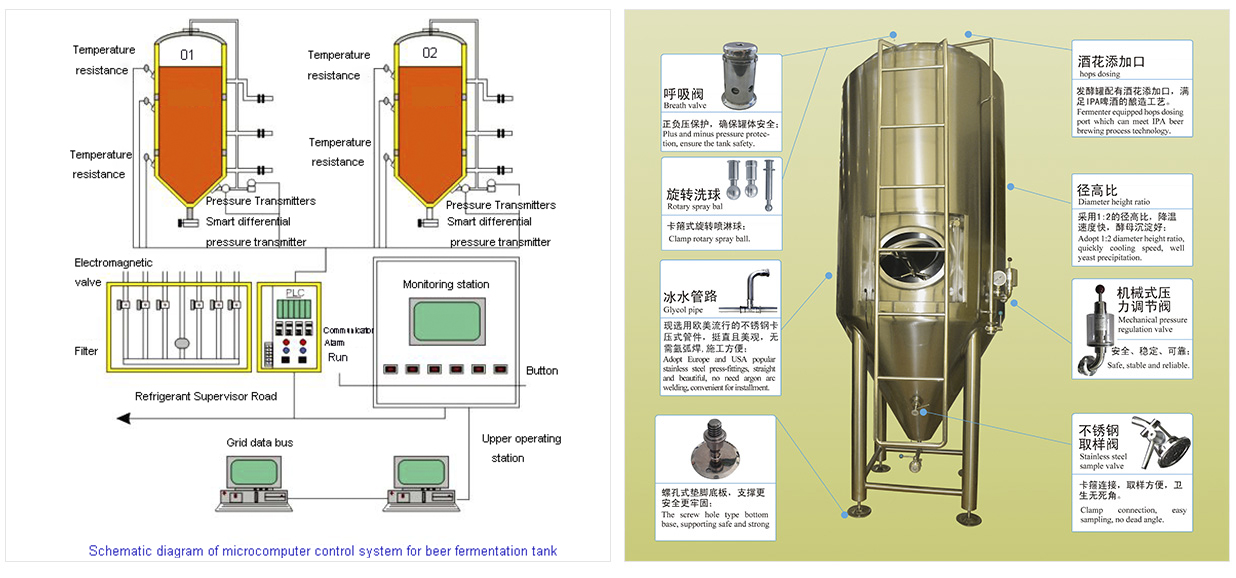
Fermentation System | Fermentation tank | -Pressure:3 Bar-Inner:3mm; outer:2mm; with insulation
-Cooling jackets |
| Accessories | Yeast Saving Tank |
Cooling System | Glycol water tank | -Inner:3mm; outer:2mm |
| Accessories | Chiller; Glycol water pump; Pipes & Valves |
CIP System | Acid tank, Caustic tank, Trolley | -Pump; Pipes & Valves -Accessories of the CIP System |
FAQ
Q: What are your payment terms, payment security and lead time?
A: We accept 40% deposit, balance paid before shipment. Irrevocable sight L/C is also acceptable. Lead time ranges from 7 to 30 days, subject to order quantity.
Q: How do we confirm product details?
A: Our professional engineers will follow up on all design and adjustments according to your requirements. OEM and ODM services are available.
Q: What services can you provide?
A: Accepted delivery terms: FOB, CFR, CIF, EXW, DDP, DDU, Express; Accepted payment currencies: USD, EUR, CNY; Accepted payment methods: T/T, L/C, Credit Card, Western Union, Alipay.
Q: How can we verify that your machines work properly?
A: We will test machine performance for you before shipment.
Q: What is your MOQ?
A: 1 set.
Beer Fermentation Tank: The Complete Guide to Stainless steel Beer fermentation Tanks for Commercial Stainless Steel Beer Brewing Tanks
Production capacity Reference (Kiloliter/year) | 500 | 1000 | 2000 | 5000 | 10000 | 20000 | Remark |
Fermenter | Volume(Kiloliter) | 2/2.5 | 4/5 | 8/10 | 15/19 | 30/38 | 60/75 | Effective/ Total volume |
ID(mm) | 1400 | 1600 | 2000 | 2800 | 3000 | 3500 |
|
Cooling area(m2) | 2.2 | 4.4 | 8.7 | 14.0 | 25 | 48 |
|
Cooling method | Dimple jacket | Dimple jacket | Dimple jacket | Dimple jacket | Dimple jacket | Dimple jacket |
|
Cone(°) | 65 | 65 | 65 | 65 | 65 | 65 |
|
BBT | Volume(Kiloliter) | 1/1.25 | 2/2.5 | 3/3.8 | 5/6.25 | 10/12.5 | 30/36 | Effective/Total volume 3-5pcs |
ID(mm) | 1100 | 1400 | 1600 | 2000 | 2200 | 2800 |
|
Cooling area(m2) | 0.8 | 1.5 | 2.2 | 3.8 | 8 | 20 |
|
Cooling method | Dimple jacket | Dimple jacket | Dimple jacket | Dimple jacket | Dimple jacket | Dimple jacket |
|
Cone(°) | / | / | / | / | / | / |
|
Beer Fermentation
Beer fermentation is a complex biochemical and material transformation process.
Primary Yeast Metabolites and Fermentation By-products
· Ethanol and carbon dioxide
· Higher alcohols, aldehydes, organic acids, esters, ketones and sulfur-containing compounds
These fermentation products determine the physicochemical properties of beer, including flavour, foam, colour and stability, and deliver the beer’s characteristic sensory profile.
Types of Fermentation
Based on the yeast strain used, beer fermentation is classified into top fermentation and bottom fermentation:
· Top-fermented beer: uses top-cropping yeast with a higher fermentation temperature of 16–22°C
· Bottom-fermented beer: uses bottom-cropping yeast with a lower fermentation temperature of 7–12°C
Fermentation Process
The overall fermentation process is broadly divided into three stages:
(1) Yeast adaptation phase
(2) Aerobic respiration phase
(3) Anaerobic fermentation phase
Fermentation is a continuous process; the material transformations during primary fermentation and secondary fermentation form an interconnected system.
During fermentation, yeast metabolism generates various by-products, some of which are subsequently degraded. The formation and partial breakdown of these by-products are tightly linked to yeast metabolism.
Ethanol Production via Glucose Fermentation
The biochemical mechanism of alcoholic fermentation from glucose is the fundamental theory for alcohol production and brewing. For beer brewing, ethanol and carbon dioxide are key beer components. In addition, the Embden–Meyerhof–Parnas (EMP) glycolytic pathway forms the basis for synthesising many flavour metabolites.
Carbohydrate Metabolism
Wort is nutrient-rich and provides a favourable habitat for yeast cells. Yeast assimilates nutrients from wort and excretes metabolites. Carbohydrates account for approximately 90% of the total wort extract. Glucose, fructose, sucrose, maltose, maltotriose and raffinose are fermentable sugars. They serve as the primary carbon source for brewer’s yeast and the core carbon substrate during fermentation.
DP9–DP12 dextrins, maltotetraose, maltopentaose through maltononaose present in wort are non-fermentable sugars, also referred to as non-sugars. In commercial production, the ratio of fermentable sugars to non-sugars is typically controlled at 7:3.
· Light refreshing beer: moderately higher proportion of fermentable sugars, high degree of fermentation and crisp taste
· Full-bodied beer: moderately higher proportion of non-sugars to enhance mouthfeel and body
Degree of Fermentation
The percentage reduction in beer extract is defined as the degree of fermentation. Residual sugar content and fermentation degree vary across beer styles. During beer fermentation, sugars are continuously consumed and the beer extract concentration declines accordingly. The concept of fermentation degree was introduced to precisely quantify the fermented fraction of wort extract, denoted by the symbol V. Fermented extract = Extract content of inoculated wort − Extract content of beer at the time of measurement
Apparent Degree of Fermentation (Vs)
During primary fermentation, extract concentration is measured with a refractometer / saccharimeter. The fermentation degree converted from this reading is the apparent degree of fermentation, which deviates from the real degree of fermentation. This deviation is proportional to the fermentation degree, and apparent extract measurement is straightforward, so breweries rely on apparent fermentation degree for process control.
· Apparent fermentation degree for pale beer: generally 68–75%
· Apparent fermentation degree for dark beer and strong beer: generally 64–73%
Real Degree of Fermentation (Vω)
First, all ethanol is distilled from the test beer sample; water is then added to restore the original volume before measuring the concentration. This value is the real extract concentration, and the fermentation degree calculated from it is the real degree of fermentation, representing the percentage of extract consumed during fermentation. Ethanol and CO₂ in the sample lower the liquid specific gravity, causing the measured apparent sugar reading to understate the true extract content. For this reason, the real fermentation degree is always lower than the apparent fermentation degree; the apparent value is normally around 20% higher. Simplified conversion formula: \(\boldsymbol{V_ω≈0.819V_S}\) The coefficient 0.819 is an empirical constant derived by Balling in 1870.
Terminal Degree of Fermentation (EV)
To establish a benchmark for fermentation performance, the proportion of fermentable substances within the total extract must be determined — this is the terminal degree of fermentation. From wort pitching through to packaging, extract loss proceeds unevenly: the rate of extract consumption in primary fermentation is far higher than in secondary fermentation.
 +86 29-87031531



 Telefon